


Email is one of the few digital channels where a business can speak directly to people who have already shown intent. They may have downloaded a brochure, abandoned a cart, requested a quote, attended a webinar or purchased before. That is why a good email marketing agency does not treat email as a monthly newsletter task. It treats email as a revenue system.
For Indian businesses, this matters even more because acquisition costs keep rising across Google Ads, Meta Ads and marketplace platforms. If every sale depends only on fresh paid traffic, margins stay under pressure. Email helps convert more of the traffic you already paid for and encourages existing customers to buy again.
A capable email marketing agency in India builds revenue by connecting strategy, data, copy, automation, deliverability and measurement. The goal is not just more opens or prettier templates. The goal is more qualified enquiries, more orders, better retention and clearer proof of what is working.
Why email still drives revenue in India
India is a mobile-first market, but that does not make email less relevant. In many categories, email plays a different role from social media, SMS or WhatsApp. Social posts create awareness, ads generate traffic and chat channels help with quick conversations. Email is where brands can explain value in detail, send structured offers, nurture leads over time and keep a record of important communication.
This is useful for e-commerce, real estate, education, healthcare, SaaS, B2B services, financial services and local retail. A parent comparing schools, a procurement manager shortlisting vendors or a D2C buyer waiting for a festival sale may not convert on the first visit. Email gives the business a way to stay useful until the buyer is ready.
Industry benchmarks often place email among the strongest ROI channels. Litmus has reported that email marketing can generate a high return compared with many other marketing investments, though actual results depend heavily on list quality, offer strength and execution. That last point is where agency expertise becomes valuable.
Revenue starts with the right audit
Before launching campaigns, a revenue-focused agency studies how your business already gets leads and sales. This audit prevents random campaign ideas from replacing actual strategy.
The agency will usually look at your website traffic, lead sources, enquiry forms, CRM data, purchase history, email list health and current sales funnel. For an e-commerce brand, the focus may be cart abandonment, repeat purchase rate, average order value and customer lifetime value. For a B2B company, the focus may be lead quality, sales cycle length, proposal follow-ups and inactive prospects.
A practical audit answers questions such as:
- Where are people dropping off before buying or enquiring?
- Which customer segments are most profitable?
- What objections stop prospects from moving forward?
- Which products or services need repeat communication before conversion?
- Which emails are already generating revenue, even if the business has not measured them properly?
This is also where an agency decides whether email should be used for acquisition support, lead nurturing, sales enablement, retention or all of these. A newsletter may be part of the plan, but it is rarely the whole plan.
| Revenue area | What the agency investigates | Why it matters |
|---|---|---|
| Lead conversion | Form submissions, enquiry quality, response time and follow-up gaps | Improves the percentage of leads that become customers |
| E-commerce sales | Browse behaviour, abandoned carts, checkout drop-offs and repeat orders | Recovers missed revenue and increases purchase frequency |
| Customer retention | Past purchase data, renewal cycles and inactive customers | Reduces dependence on new customer acquisition |
| Sales support | Proposal follow-ups, demo reminders and education emails | Helps the sales team close warm prospects faster |
| Brand trust | Reviews, case studies, testimonials and content assets | Makes prospects more confident before they buy |
Building a consented, useful email list
Revenue does not come from sending emails to as many people as possible. It comes from sending relevant emails to people who have a genuine reason to hear from you. In India, this is now a business and compliance issue.
The Digital Personal Data Protection Act, 2023 has pushed brands to take consent and data handling more seriously. For marketers, the practical takeaway is simple: collect email addresses transparently, explain why you are collecting them and avoid buying random databases that can damage trust and deliverability.
An agency can help a business build its email list through high-intent sources such as website forms, checkout opt-ins, lead magnets, webinar registrations, gated guides, consultation requests, loyalty programmes and post-purchase communication. The quality of these sources matters more than the size of the list.
For example, a Chennai-based interior design firm may collect leads from a cost estimator, design consultation form and downloadable portfolio. A Shopify store may collect emails through first-order offers, back-in-stock alerts and post-purchase product education. A B2B software company may use demo requests, comparison pages and webinar sign-ups.
The agency’s job is to match the opt-in method to the buyer journey. A person downloading a beginner guide should not receive the same email sequence as someone asking for pricing.
Segmentation turns a list into a revenue asset
A single email blast is easy to send, but it usually leaves money on the table. Segmentation allows the agency to tailor messages based on what people care about and how close they are to buying.
Common segments include new leads, first-time buyers, repeat customers, dormant subscribers, high-value customers, cart abandoners, location-based audiences and product-interest groups. In India, segmentation may also consider city, language preference, festival buying patterns, payment preference or whether a buyer responds better to educational content or direct offers.
This makes email feel less generic. A person who bought a skincare product can receive usage tips, replenishment reminders and complementary product recommendations. A B2B lead who attended a webinar can receive case studies, comparison content and a consultation invitation. A college enquiry can receive course outcomes, placement information, fee reminders and parent-focused trust content.
Segmentation also protects revenue by reducing unsubscribes and spam complaints. People are more tolerant of email when the content matches their needs.
Automation converts intent at the right moment
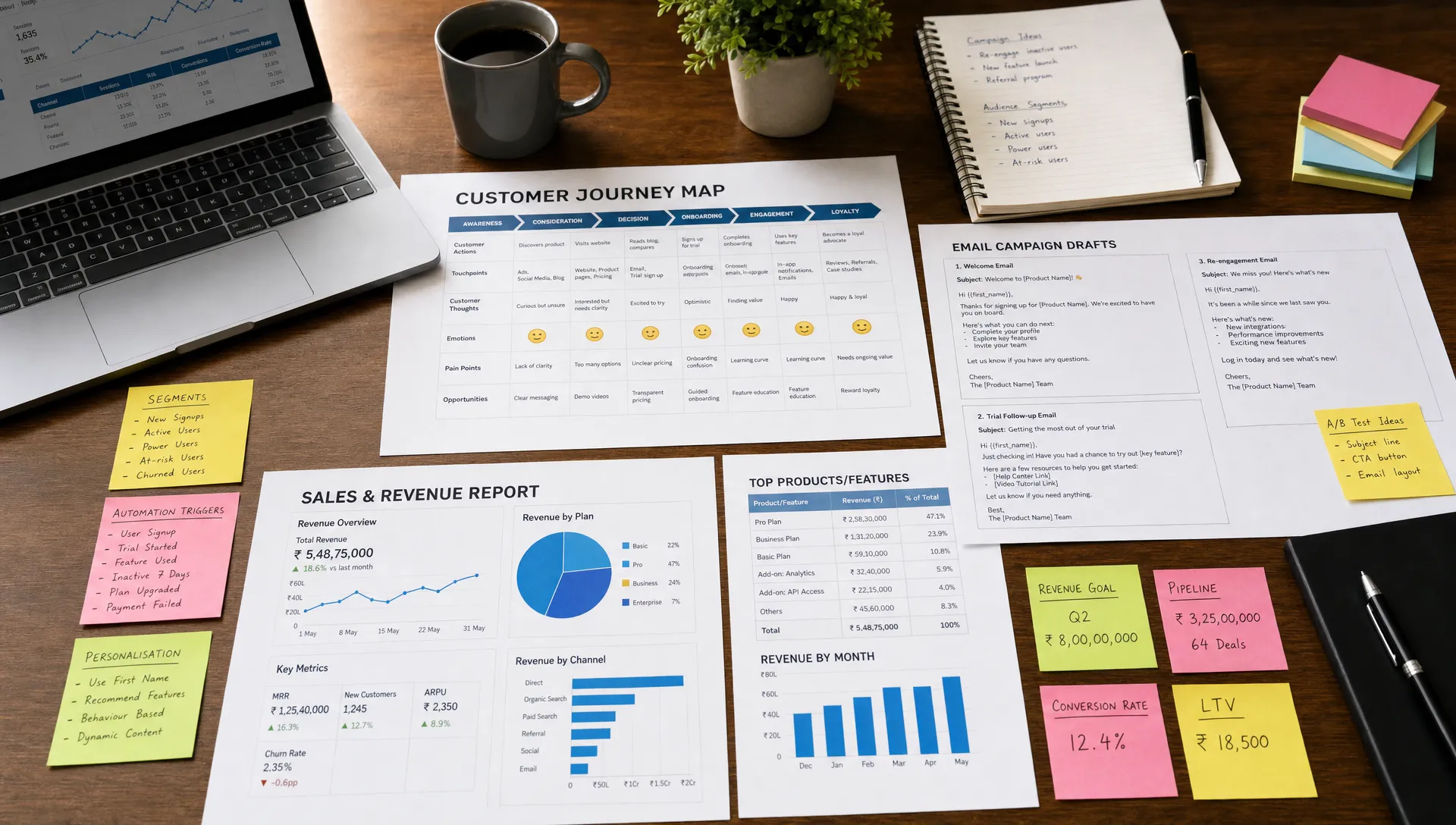
Manual email campaigns depend on someone remembering to send the right message. Automation creates a system that responds when a user takes an action. This is one of the clearest ways an email marketing agency builds revenue.
For e-commerce brands, automation can recover carts, recommend related products, win back inactive customers and ask for reviews. For service businesses, it can nurture enquiries, remind prospects about consultations, share proof points and help the sales team prioritise warm leads.
| Automated email flow | Best suited for | Revenue role |
|---|---|---|
| Welcome sequence | New subscribers and fresh leads | Introduces the brand, builds trust and guides the next step |
| Abandoned cart flow | E-commerce shoppers | Recovers incomplete purchases without extra ad spend |
| Lead nurture sequence | B2B, education, real estate and services | Educates prospects until they are ready for sales contact |
| Post-purchase flow | E-commerce and local service brands | Encourages repeat purchase, reviews and referrals |
| Re-engagement flow | Inactive subscribers or old leads | Revives interest or cleans the list if users stay inactive |
| Renewal or replenishment reminders | Subscription, consumable or contract-based businesses | Protects recurring revenue and repeat orders |
Automation should not feel robotic. The best flows are built around real buyer questions. If customers ask about delivery, warranty, pricing, outcomes, comparisons or support, those answers belong in the sequence.
Copy and creative make the offer believable
Many campaigns fail because the offer is unclear, not because the channel is weak. An agency improves revenue by sharpening what the email actually says.
Good email copy answers four questions quickly: who is this for, what is being offered, why should the reader trust it and what should they do next? The answer may be a product purchase, a demo booking, a quote request, a consultation call, an event registration or a repeat order.
For Indian audiences, context matters. A festive offer may need urgency, but a B2B solution may need proof and clarity. A local business may need location cues and phone support. A high-consideration purchase may need testimonials, FAQs and comparison content before a sales pitch.
Design matters too, especially on mobile. Emails should load fast, use readable text, make the call to action obvious and avoid relying only on images. If the email looks attractive but the button is hard to tap, revenue suffers.
Deliverability protects the money behind the campaign
Deliverability is the hidden side of email revenue. A campaign cannot sell if it lands in spam or gets blocked. Agencies manage the technical and behavioural factors that decide whether your emails reach the inbox.
This includes domain authentication, bounce control, spam complaint monitoring, list cleaning, unsubscribe management and sender reputation. Google’s email sender guidelines place clear emphasis on authentication, low spam rates and easy unsubscribes, especially for bulk senders.
Technical setup usually includes SPF, DKIM and DMARC records. These records help mailbox providers verify that your emails are genuinely sent by your domain. Agencies also monitor engagement patterns. If many subscribers ignore campaigns, the agency may suppress inactive contacts, create a re-engagement campaign or change sending frequency.
This is not just a technical exercise. Better deliverability improves the number of people who actually see the campaign, which directly affects enquiries and sales.
Email works better when connected to other channels
Email should not sit separately from the rest of your digital marketing. A customer may first discover your brand through SEO, return through a remarketing ad, ask a question on WhatsApp and finally convert after receiving an email with proof and pricing clarity.
A revenue-focused agency maps these touchpoints together. For example, email can follow up with leads generated through PPC landing pages. It can distribute content created for SEO. It can support social media campaigns by inviting subscribers to launches, events or offers. It can also work with SMS for urgent reminders, especially when timing matters.
If your business already uses multiple communication channels, the guide on integrating email and SMS marketing strategies explains how email’s depth and SMS’s immediacy can work together without overwhelming customers.
The key is channel discipline. Email is strong for education, nurturing and structured offers. SMS is strong for time-sensitive alerts. WhatsApp is strong for conversations and quick responses. Paid ads are strong for reach. When each channel has a job, the customer experience feels smoother and the business gets more value from every lead.
Measurement links campaigns to revenue
An agency that focuses only on open rates is not managing revenue properly. Open rates can be useful as a directional signal, but privacy changes and inbox behaviour make them less reliable than business metrics.
Revenue measurement should include clicks, conversion rate, assisted conversions, generated enquiries, recovered carts, repeat purchases, unsubscribe rate, spam complaint rate and revenue per recipient. For B2B, it may also include meeting bookings, sales-qualified leads, proposal requests and closed deals influenced by email.
A good agency builds reporting around the business model. An e-commerce brand needs product revenue and customer lifetime value. A real estate company needs site visits and qualified enquiries. An education brand needs applications, counselling calls and admissions. A SaaS company needs demos, trials, activation and renewals.
Testing is part of this process. Agencies can test subject lines, send times, offers, landing pages, call-to-action wording and audience segments. The goal is not to run random A/B tests forever. The goal is to learn what moves people closer to purchase.
| Metric | What it tells you | How an agency uses it |
|---|---|---|
| Click-through rate | Whether the message and offer created interest | Improves copy, design and call-to-action placement |
| Conversion rate | Whether clicks turned into business outcomes | Fixes landing pages, offers and follow-up journeys |
| Revenue per recipient | How much value each send generates | Prioritises profitable segments and campaigns |
| Unsubscribe rate | Whether frequency or relevance is causing fatigue | Adjusts targeting, content and sending cadence |
| Spam complaint rate | Whether subscribers find the email unwanted | Protects deliverability and list trust |
| Repeat purchase rate | Whether email is improving retention | Strengthens post-purchase and loyalty campaigns |
How to know if an agency can build revenue, not just send emails
When choosing an email marketing partner, look for strategic thinking before creative samples. Templates matter, but they are not enough. The agency should ask about margins, sales process, lead quality, customer lifetime value and the channels that feed your email list.
You should also expect clarity on list hygiene, consent, automation, deliverability, reporting and integration with your CRM or website. If the agency talks only about sending bulk emails at low cost, it may not be the right partner for long-term growth.
A strong agency will also understand how email fits into SEO, PPC, content marketing, web design and reputation building. This is important because email often converts demand created elsewhere. If you are still comparing options, this practical guide on how to choose a digital marketing company in India can help you evaluate strategy depth, proof and fit.
Frequently Asked Questions
What does an email marketing agency in India do? An email marketing agency in India plans campaigns, builds subscriber journeys, segments audiences, writes email content, sets up automation, manages deliverability and measures revenue outcomes such as leads, sales and repeat purchases.
How does email marketing increase revenue? Email increases revenue by converting existing leads, recovering abandoned carts, nurturing prospects, encouraging repeat purchases and reactivating inactive customers. It improves the value of traffic you already receive from SEO, ads, social media and referrals.
Is email marketing useful for small businesses in India? Yes. Small businesses can use email to follow up with enquiries, promote offers, share trust-building content and bring previous customers back. The key is to start with a clean list and relevant messages rather than sending bulk emails to cold databases.
How long does it take to see revenue from email marketing? Some flows, such as abandoned cart emails or enquiry follow-ups, can show results quickly if the list and website traffic already exist. Lead nurturing and retention programmes usually improve over several weeks or months as data accumulates.
Should email marketing be combined with SMS or WhatsApp? In many Indian campaigns, yes. Email is better for detailed content, offers and education. SMS and WhatsApp can support reminders, confirmations and quick responses. The best mix depends on consent, customer preference and the type of purchase.
Build an email system that supports real sales
Email marketing becomes profitable when it is connected to your customer journey, not treated as a standalone broadcast channel. The right strategy can help you convert more leads, recover missed sales, increase repeat purchases and reduce dependence on paid acquisition.
Gilead Digital is a Chennai-based digital marketing agency offering email marketing solutions along with SEO, PPC, content marketing, web design and other growth services. If you want email to work as part of a broader revenue strategy, connect with Gilead Digital and start building a more accountable digital marketing engine.