

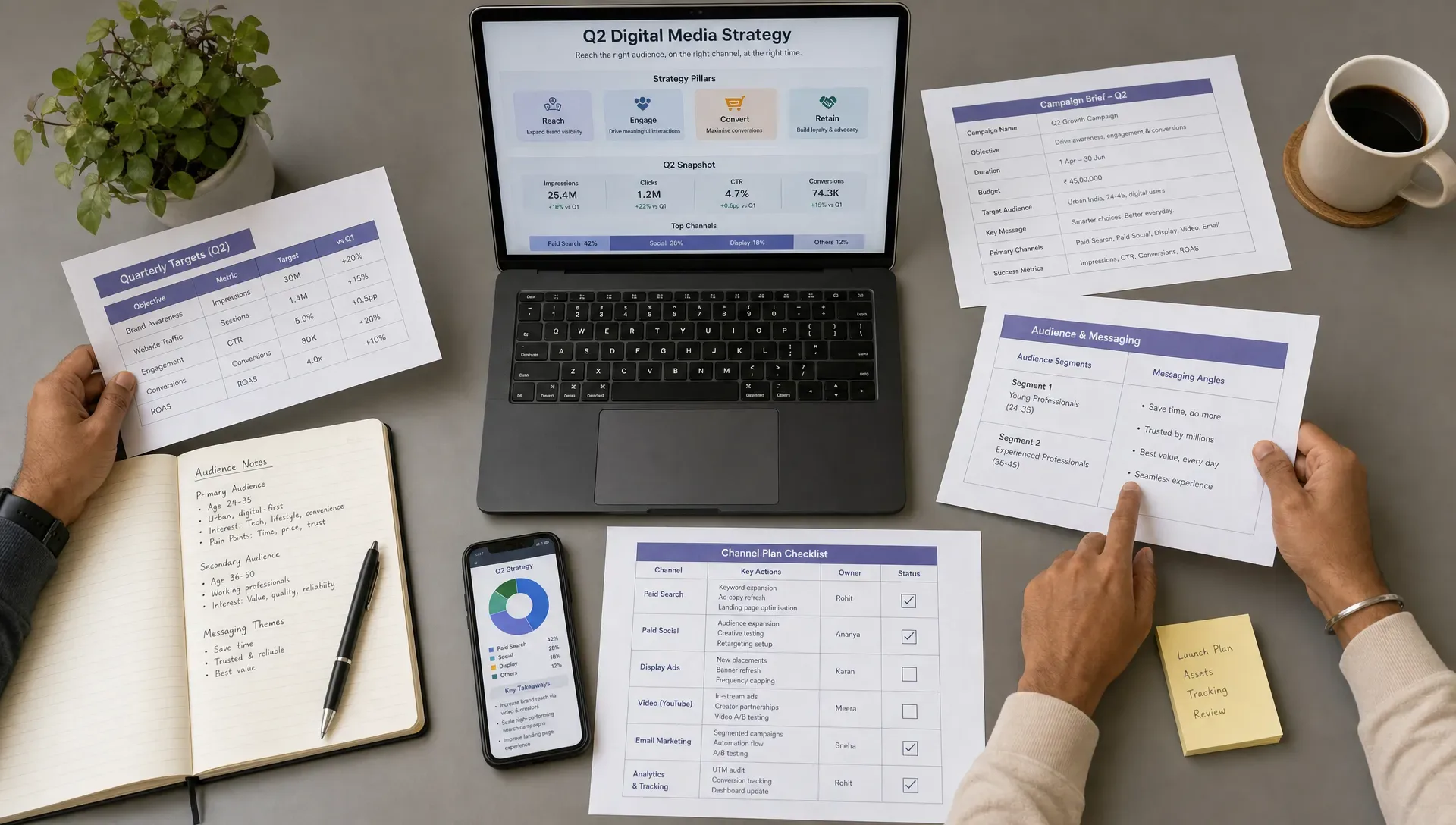
Reach is easy to buy, but profitable reach is harder to build. A digital media strategy gives every campaign a job: attract the right audience, turn attention into leads and connect marketing activity with revenue. Without that structure, businesses often spend on ads, posts and content without knowing which effort is moving the pipeline.
For many Indian SMBs, the problem is not a lack of channels. It is a lack of alignment. SEO, paid ads, social media, email and the website may all be active, but they do not always point to the same commercial goal. A good plan reduces that waste by deciding who to reach, what to say, where to spend and how success will be measured.
Build your digital media strategy around business outcomes
Start with the business outcome before you choose platforms. A restaurant chain trying to increase table bookings needs a different plan from a B2B software firm that wants demo requests or a hospital that wants appointment enquiries. Channel decisions become clearer when they are tied to a revenue target, average order value, sales cycle and lead quality requirement.
Your plan should answer three practical questions. Who is most likely to buy, what problem makes them search or respond and what action should they take next? If these questions are vague, campaigns will optimise for easy metrics like impressions or likes instead of sales conversations.
Turn the revenue number into channel goals
Work backwards from the revenue target. If you need 100 new customers this quarter and your sales team closes 20 percent of qualified leads, marketing must generate roughly 500 qualified opportunities. From there, you can estimate traffic, conversion rate, cost per lead and the mix of organic and paid channels needed to reach the number.
Document the commercial assumptions behind your digital media strategy: target markets, lead stages, expected close rates, campaign budgets and the time needed for each channel to mature. SEO may take months to compound, while paid search can test demand faster. Both can work together, but they should not be judged on the same timeline.
| Business outcome | Media role | Useful KPIs |
|---|---|---|
| Increase brand visibility | Reach relevant buyers before they are ready to enquire | Reach, branded searches, engaged sessions |
| Generate qualified leads | Capture high-intent demand and move users to forms, calls or chats | Conversion rate, cost per lead, lead quality |
| Grow revenue | Nurture leads and improve sales efficiency | Sales qualified leads, customer acquisition cost, ROAS |
Define audience segments by intent
Audience planning should go deeper than age, city and income. A buyer looking for best dental implant clinic in Chennai is showing different intent from someone browsing dental care tips. One is close to taking action, the other may need education and trust building first.
Group audiences by intent stage: unaware, problem aware, solution aware and ready to buy. This helps you decide whether the message should educate, compare, persuade or convert. It also prevents the common mistake of showing a hard sales message to people who still need basic context.
Map channels to reach, lead capture and conversion
Your digital media strategy should assign one primary job to each channel instead of asking every channel to do everything. Social media may build familiarity and community, search may capture demand, email may nurture leads and landing pages may convert traffic into enquiries. When each channel has a role, reporting becomes easier and budget decisions become less emotional.
A simple channel map helps teams avoid random posting or scattered ad spending. It also clarifies where content is needed, where paid promotion should support organic activity and where the website must remove friction.
| Channel | Best role | Common mistake to avoid |
|---|---|---|
| SEO and organic search | Capture long-term demand and build topical authority | Publishing without matching search intent |
| PPC and search ads | Test high-intent demand and generate faster leads | Paying for clicks without conversion tracking |
| Social media | Build recall, trust and engagement | Posting often without a buyer journey |
| Email and SMS | Nurture prospects and reactivate customers | Sending the same message to every contact |
| Website and landing pages | Convert visitors into leads or sales | Driving traffic to slow or generic pages |
If you are still deciding which channels deserve priority, Gilead Digital has a practical overview of digital marketing techniques that drive measurable growth. Use it as a channel checklist, then narrow your focus based on audience intent and budget.
Use paid and organic together
Paid and organic media should not compete for attention inside your team. Paid campaigns can test keywords, offers and landing pages quickly. SEO and content can then turn proven themes into long-term assets. Social content can repackage those insights into shorter formats that create recognition before buyers search.
For example, a real estate developer could use Google Ads for location-specific enquiries, SEO for guides on neighbourhoods and home loans, social media for project credibility and email for follow-ups after site visits. The same message does not have to appear everywhere, but the story should feel connected.
If paid search is part of the mix, focus on qualified enquiries rather than traffic volume. Gilead Digital explains this difference in its guide to SEM services that deliver better leads, which is especially useful for businesses spending on Google Ads.
Create content that moves buyers forward
In a practical digital media strategy, content is not just a posting calendar. It is the bridge between buyer questions and business outcomes. Every article, ad, reel, email or landing page should reduce doubt, increase relevance or move the prospect to the next step.
Start by mapping content to the decision journey. Early-stage buyers need clarity on the problem. Middle-stage buyers need comparisons, proof and use cases. Late-stage buyers need pricing context, case studies, testimonials, FAQs and a simple way to contact you.
A balanced content system usually includes:
- Educational content that answers search queries and builds trust
- Proof content such as case studies, reviews and before-after examples
- Conversion content such as landing pages, offer pages and enquiry forms
- Nurture content such as email sequences, WhatsApp updates and retargeting ads
Email is often underestimated in this journey. Once someone downloads a guide, requests a quote or abandons a cart, email can keep the conversation alive without relying only on fresh ad spend. For a deeper view, see how an email marketing agency in India builds revenue through segmentation, automation and lifecycle messaging.
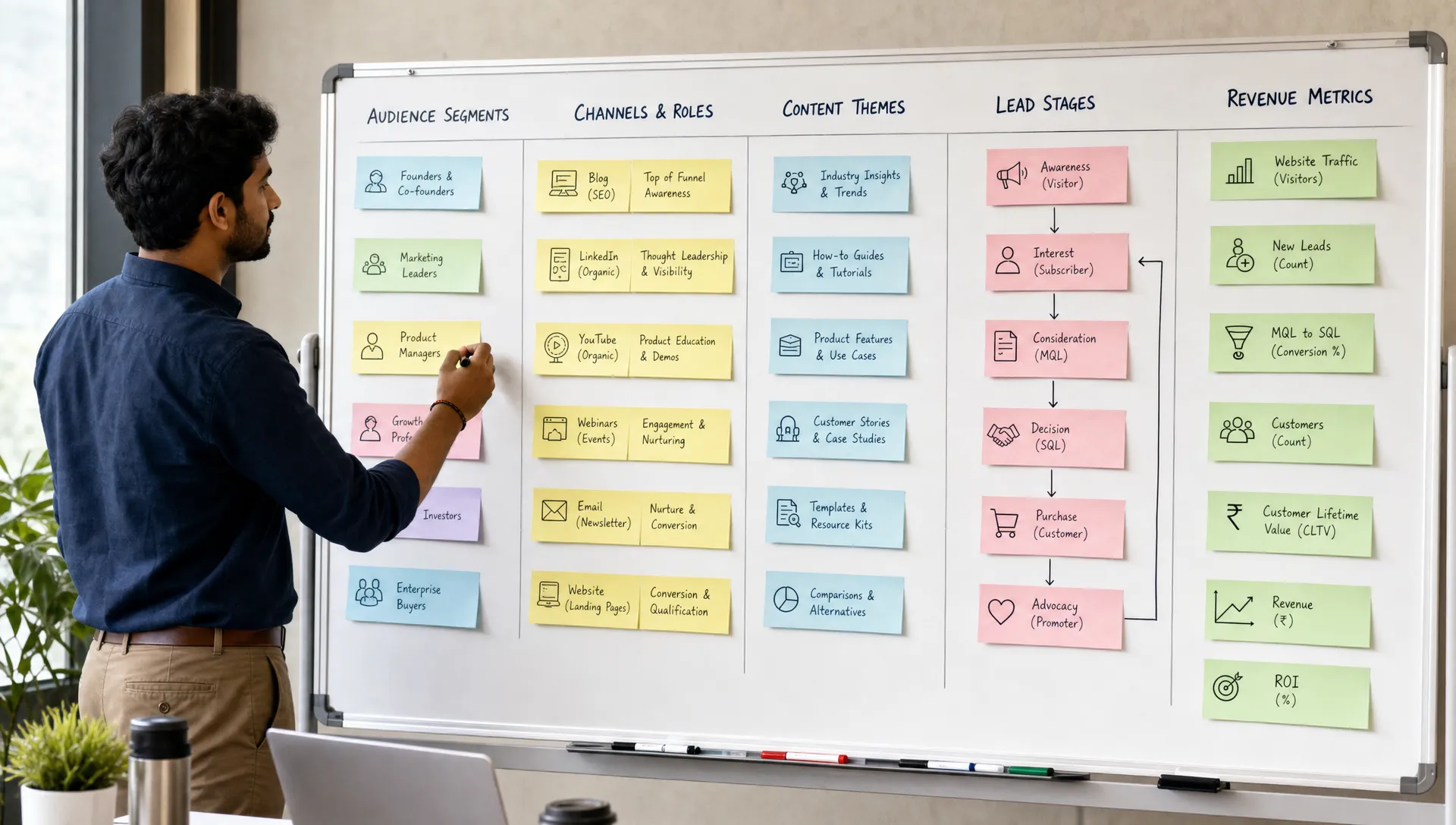
Measure the full path from reach to revenue
Measurement should begin before campaigns go live. Decide which actions count as meaningful progress: calls, form submissions, demo requests, appointment bookings, purchases or repeat orders. Then make sure those actions are tracked properly across the website, ad platforms and CRM.
Traffic alone is not a strategy metric. A campaign that brings fewer visitors but more qualified leads may be more valuable than a campaign with high impressions and no sales conversations. This is why conversion tracking, lead source tagging and sales feedback matter.
| Funnel stage | What to measure | Why it matters |
|---|---|---|
| Reach | Impressions, reach, video views, branded search lift | Shows whether the right audience is seeing you |
| Engagement | Click-through rate, engaged sessions, content depth | Shows whether the message is relevant |
| Lead capture | Calls, forms, chats, bookings, cost per lead | Shows whether traffic is turning into opportunities |
| Sales impact | Qualified leads, close rate, revenue, repeat purchases | Shows whether marketing is creating business value |
A digital media strategy becomes commercially useful when marketing data and sales data speak to each other. If the sales team says leads from one campaign are poor, investigate the keyword, audience, form promise and follow-up speed. If one campaign creates fewer leads but better customers, increase investment there instead of chasing cheaper volume.
For tracking, platforms such as Google Analytics 4 allow businesses to mark important actions as key events. Pair that with CRM notes or lead status updates so you can distinguish between a raw enquiry and a revenue opportunity.
Optimise budgets with a quarterly operating rhythm
Treat your digital media strategy as a quarterly operating system, not a one-time presentation. Markets change, competitors increase bids, search behaviour shifts and creative fatigue sets in. A monthly performance review and a quarterly strategy refresh keep the plan connected to reality.
Budget optimisation should look at marginal returns. If branded search already captures most existing demand, extra spend there may not create much growth. If a service page ranks on page two of Google and converts well, SEO improvement could unlock a better return than adding another social campaign. The right answer depends on performance data, sales capacity and the value of each customer.
Review performance by channel role
Do not judge every channel by last-click revenue alone. Social media may influence buyers before they search. SEO may educate prospects who convert later through direct traffic. Email may revive old leads that paid ads originally acquired. A fair review asks whether each channel is doing its assigned job.
At the same time, do not let influence become an excuse for weak performance. If a channel cannot show reach quality, engagement, assisted conversions or lead contribution, it needs a sharper role or a smaller budget.
Build a test and learning backlog
Every quarter, list the experiments that could improve results. This might include a new landing page, a revised ad offer, a new content cluster, a different call-to-action or a remarketing sequence for warm visitors. Prioritise tests by expected impact and ease of execution.
Keep tests clean. Changing the audience, creative, landing page and offer at the same time makes it hard to know what worked. A disciplined testing rhythm helps the team learn faster and prevents budget from being spent on guesswork.
Common mistakes that weaken performance
The most common digital media strategy mistake is starting with tactics before deciding the commercial goal. A business may launch reels, ads, blogs and email campaigns in the same month, but if the offer, audience and conversion path are unclear, activity increases without reliable growth.
Another mistake is separating brand and performance too sharply. Brand activity without conversion paths can become expensive awareness. Performance activity without trust building can become aggressive and short-lived. The best plans use brand signals, proof and direct response together.
A third issue is ignoring the website. If the site loads slowly, hides contact details or uses generic service pages, even strong campaigns will underperform. Media can bring people to your door, but the website must convince them to take the next step.
Frequently Asked Questions
What should a media plan include? It should include business goals, audience segments, channel roles, content themes, budget allocation, conversion paths, tracking setup and a review rhythm.
How long does it take to see results? Paid campaigns can generate learning within weeks, but SEO, content and brand building often need several months to show compounding results. The timeline depends on competition, budget and execution quality.
Which channel is best for lead generation? There is no universal best channel. High-intent search often works well for urgent demand, while social, email and content can support trust building and nurturing.
How often should performance be reviewed? Review tactical metrics weekly or biweekly, campaign performance monthly and strategic direction quarterly. This keeps short-term optimisation aligned with long-term revenue goals.
Turn planning into measurable growth
If your business needs a digital media strategy that connects reach, lead generation and revenue, start by clarifying the outcome, then build the channel mix around that outcome. The strongest plans are not the busiest. They are the ones where every campaign has a role, every lead source is measured and every learning cycle improves the next decision.
Gilead Digital helps businesses in Chennai and across India plan and execute SEO, PPC, social media, content, web design and performance marketing campaigns. To discuss a growth plan for your business, visit Gilead Digital and take the next step toward more accountable marketing.