
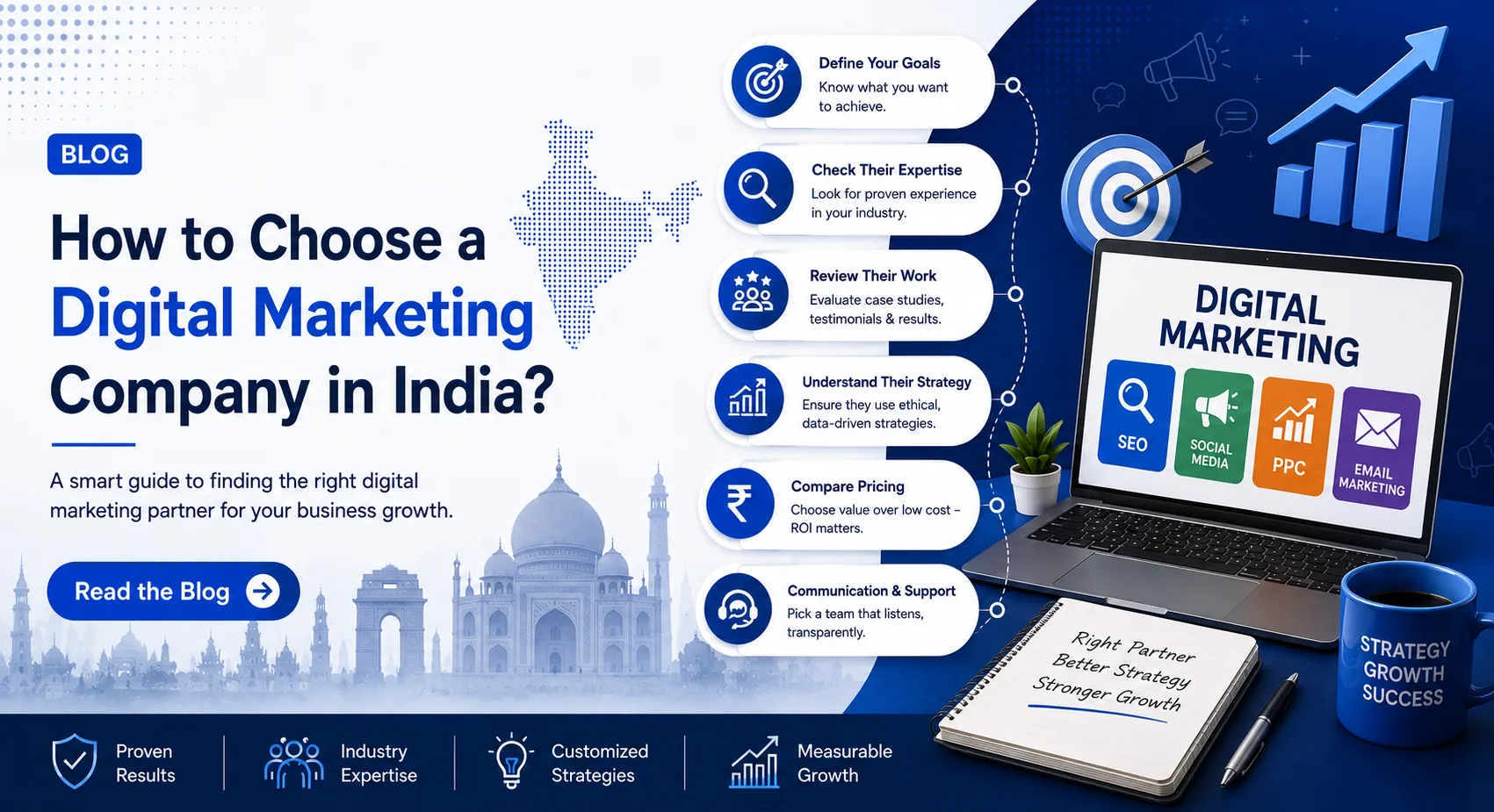
Choosing a marketing partner is one of the highest leverage decisions you will make for growth. In India, the options are endless, from solo consultants to full service agencies, and the pitches often sound identical. The difference shows up later in execution: lead quality, CAC, reporting clarity, and whether you actually own your data and ad accounts.
This guide helps you choose a digital marketing company in India with a clear, practical evaluation framework, so you can compare proposals fairly and avoid costly mismatches.
Step 1: Get clear on your goals before you shortlist agencies
A good agency will ask you questions before it offers you a package. If you are not fully sure what you need, define these basics internally first:
- Primary business goal: revenue growth, lead generation, footfall, app installs, retention, brand trust.
- Sales cycle: instant purchase (e-commerce) vs considered purchase (B2B, healthcare, education, real estate).
- Geography: pan-India vs city-wise (Chennai, Bengaluru, Kochi, etc.) vs hyperlocal.
- Budget and runway: how long you can invest before judging results (SEO needs more runway than PPC).
- Capacity to handle leads: can your team respond quickly, qualify leads, and follow up.
If you skip this step, you tend to buy “services” (SEO, ads, social) instead of buying outcomes (qualified pipeline, repeat customers, predictable revenue).
Step 2: Match your goal to the right mix of channels
Not every business needs everything. The best digital marketing company will propose a mix based on your funnel and unit economics, not a one size fits all plan.
| Your objective | Channels that often fit | What “good” looks like (example KPIs) |
|---|---|---|
| Generate high intent leads | SEO for commercial queries, Google Ads search, landing page CRO | Cost per qualified lead, lead to meeting rate, conversion rate |
| Launch a new brand or product | Paid social, creators, video content, PR support, remarketing | Reach, engaged sessions, assisted conversions |
| Drive local enquiries | Google Business Profile optimisation, local SEO, reviews, call tracking | Calls, direction requests, local rankings |
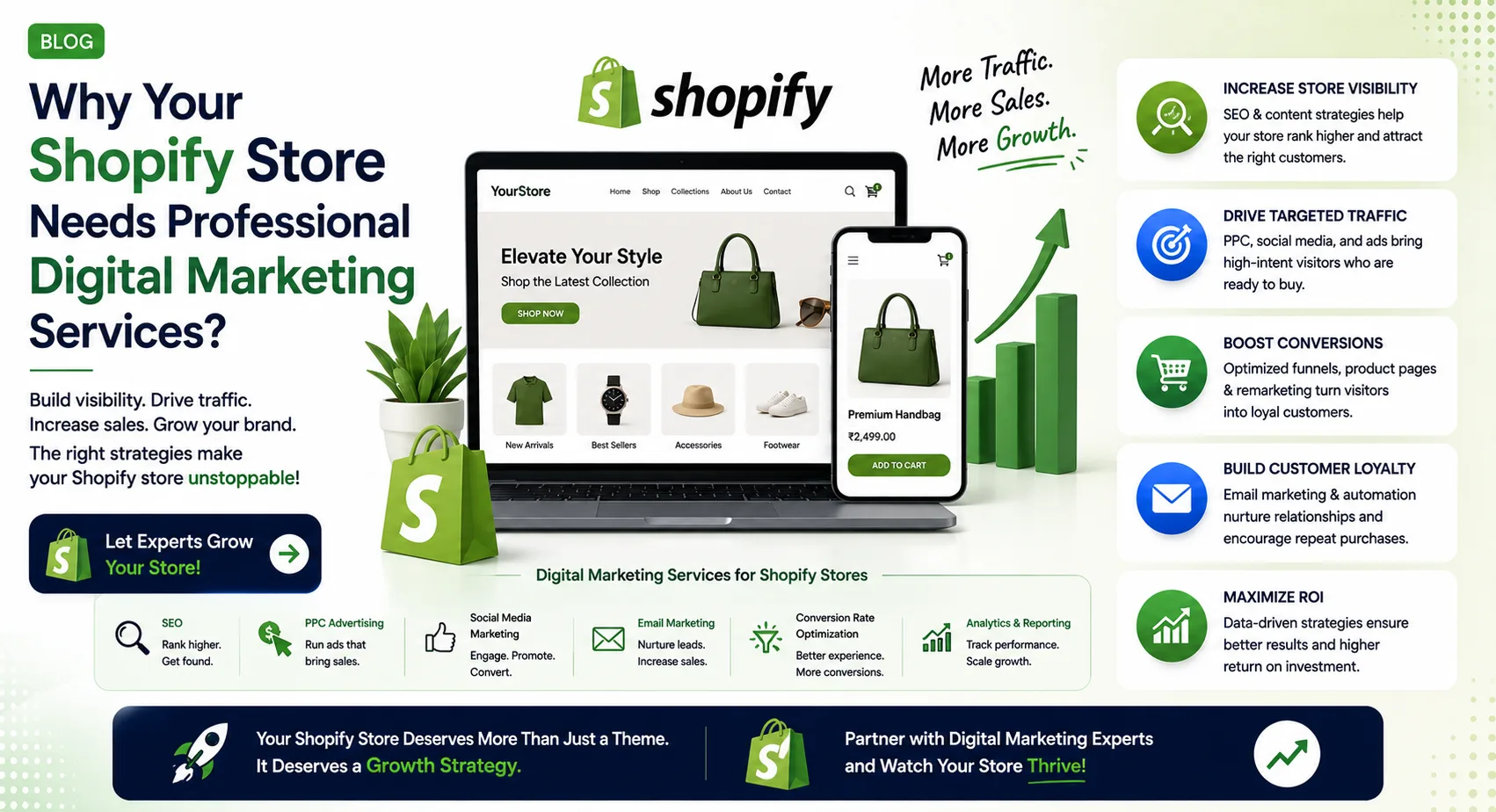
| Scale e-commerce revenue | Shopping ads, SEO category pages, retention email/SMS, CRO | ROAS, CAC, AOV, repeat purchase rate |
| Improve trust and reduce churn | Online reputation management, content, email journeys | Review ratings, NPS indicators, retention metrics |
If an agency pushes SEO only for a business that needs immediate leads next month, or pushes ads only for a business with weak landing pages and poor follow up, you are likely to waste spend.
Step 3: Evaluate strategy depth, not just deliverables
Many proposals list outputs: “X blogs, Y backlinks, Z creatives.” A stronger sign is a plan that explains why each activity maps to your revenue.
Look for:
- Discovery and audit first: website health, tracking, competitor benchmarks, keyword and audience research.
- Positioning clarity: how you will be differentiated in a crowded Indian market.
- Funnel thinking: what will attract, convert, and nurture.
- Prioritisation: what happens in month 1 vs month 3.
If you already have existing marketing, ask how they will handle migration without breaking what works (analytics, conversions, SEO URLs, ad learning).
Step 4: Ask for proof, and know what proof should contain
Case studies and references matter, but they must be interpretable.
A reliable case study usually includes:
- Starting point (baseline traffic, leads, rankings, conversion rate)
- What was changed (technical fixes, content strategy, campaign structure)
- Time period and constraints (seasonality, budget limits)
- Outcomes tied to business metrics (not only impressions)
If an agency only shows vanity metrics, ask follow ups. For example, organic impressions without clicks, or leads without qualification, can hide poor performance.
If you want an example of what a structured SEO case study can look like, review a published case study from the agency’s own site (for instance, Gilead Digital has shared SEO growth learnings and results in its blog, such as the Nattika Beach Resort SEO success story).
Step 5: Confirm who will actually work on your account
In India, many agencies sell with senior people and deliver with juniors. That is not automatically bad, but you should know the working model.
Ask:
- Who is the day to day point of contact?
- Will you have specialists for SEO, ads, content, design, development?
- What is the approval workflow for creatives, content, and website changes?
- How many accounts does your account manager handle?
A healthy sign is role clarity and a realistic workload.
Step 6: Make reporting and measurement non-negotiable
The biggest client-agency conflicts come from “results” being undefined. Before you sign, align on what will be tracked, how often, and where.
At minimum, your marketing partner should be comfortable working with:
- Google Analytics 4 (GA4) for behaviour and conversions
- Google Search Console for SEO performance
- Google Ads and Meta Ads dashboards for paid reporting
- Tag management and conversion tracking (typically via GTM)
Also confirm attribution expectations. For many Indian SMBs, WhatsApp, phone calls, and walk-ins are a major part of conversion. If those are important for you, discuss call tracking, CRM capture, and lead quality checks.

Reporting checklist you can use
| Area | What to ask for | Why it matters |
|---|---|---|
| KPI definitions | “How do you define a qualified lead?” | Prevents inflated lead counts |
| Cadence | Weekly snapshot plus monthly deep dive | Balances speed and insight |
| Access | Shared access to GA4, Search Console, ad accounts | Ensures you own your data |
| Insights | “What did you learn and what will you change next?” | Reporting should drive action |
Step 7: Watch for SEO and ads practices that can harm your brand
Some shortcuts create short term spikes and long term damage.
SEO ethics
Avoid agencies that promise “#1 ranking in 30 days” or push link schemes. Google’s own guidance emphasises building helpful content and avoiding manipulative tactics (see Google Search Essentials).
Ask what their link building philosophy is. A safe answer usually includes content-led authority building, digital PR, and technical SEO, not paid link networks.
Review and reputation ethics
If online reputation management is part of your plan, do not accept fake reviews or incentive tactics that violate platform policies. They can backfire and hurt trust.
Paid ads ethics
For ads, confirm they follow platform rules and local category constraints (health, finance, education, real estate can have stricter policies). You want compliant creatives and accurate claims.
Step 8: Check contracts, ownership, and exit terms
This is where many businesses in India get stuck later.
Confirm in writing:
- Ad account ownership: ideally, your business owns the Google Ads and Meta ad accounts.
- Website and domain ownership: you should own your domain, hosting access, and admin credentials.
- Creative and content ownership: what happens to landing pages, ad creatives, and blog content if you stop.
- Payment and invoicing: GST invoices, billing cycle, and any media spend handled by the agency.
- Lock-in period and exit: notice period, handover support, and data export.
A professional agency will not hesitate to clarify these.
Step 9: Ask about data privacy and consent (important in 2026)
Marketing increasingly touches personal data: lead forms, email lists, remarketing audiences, WhatsApp communication.
India’s Digital Personal Data Protection Act, 2023 makes privacy and consent workflows more important. Your agency should be able to discuss:
- Consent language on lead forms
- Cookie banners and tracking disclosure (where applicable)
- Data retention basics (how leads are stored, shared, and deleted)
You do not need a legal lecture from an agency, but you do need mature processes.
Step 10: Compare proposals using a simple scorecard
To keep decisions objective, score your top options on factors that impact outcomes.
| Criteria | What “good” looks like | Score (1 to 5) |
|---|---|---|
| Strategy | Clear plan tied to your goals and funnel | |
| Proof | Relevant case studies with context and timelines | |
| Team | Named roles, specialist coverage, communication clarity | |
| Measurement | Strong tracking plan, KPI clarity, access sharing | |
| Execution fit | Can they deliver the channels you need (SEO, PPC, web, content) | |
| Transparency | Pricing clarity, ownership terms, realistic expectations | |
| Compliance | Ethical SEO/ads, privacy awareness, platform-safe approach |
Do not automatically choose the lowest quote. In digital marketing, cheap often becomes expensive through wasted months and wrong traffic.
Step 11: Decide the right model (agency vs freelancer vs in-house)
There is no universal best choice, only best fit.
| Model | Best for | Trade-offs |
|---|---|---|
| Freelancer | Narrow scope (SEO audits, content, specific ad channel) | Limited capacity, less redundancy |
| Agency | Multi-channel execution, strategy plus production | Needs strong communication, risk of being “one of many” |
| In-house | Full control, long-term compounding knowledge | Hiring cost, training time, tool stack cost |
Many Indian SMBs succeed with a hybrid: keep one internal marketing owner, partner with an agency for execution depth.
Step 12: Start with a pilot (and define what success means)
If you are unsure, a pilot reduces risk. Examples of pilots that reveal quality quickly:
- SEO audit plus a 60 to 90 day implementation sprint
- Paid search campaign focused on one service line and one city
- Landing page build plus conversion tracking setup
Agree upfront on what will be delivered, what decisions will be made from the data, and what “continue vs stop” thresholds look like.
Questions to ask a digital marketing company in India (use these in your calls)
- What do you need from us (access, approvals, content inputs) to succeed?
- Which KPIs will you optimise first, and why?
- How do you define and measure a qualified lead?
- How will you handle tracking setup and attribution limitations?
- What is your approach to SEO links and content quality?
- Will we own the ad accounts, website assets, and data?
- What does month 1 look like in terms of actions and milestones?
Red flags that should make you pause
- Guaranteed rankings or guaranteed lead counts without knowing your market
- No mention of tracking, conversion setup, or lead quality
- Refusal to share account access (ads, analytics, Search Console)
- Only vanity reporting (likes, impressions) for performance goals
- Unclear deliverables and no documented process
- Pushy long lock-in terms with weak exit support
Work with a Chennai-based team that understands Indian markets
If you want a partner that can support SEO, PPC, web design, content marketing, social media marketing, and online reputation management under one roof, explore Gilead Digital. Share your goals and current challenges, and the team can recommend a practical plan, whether you need a full engagement or a focused audit.