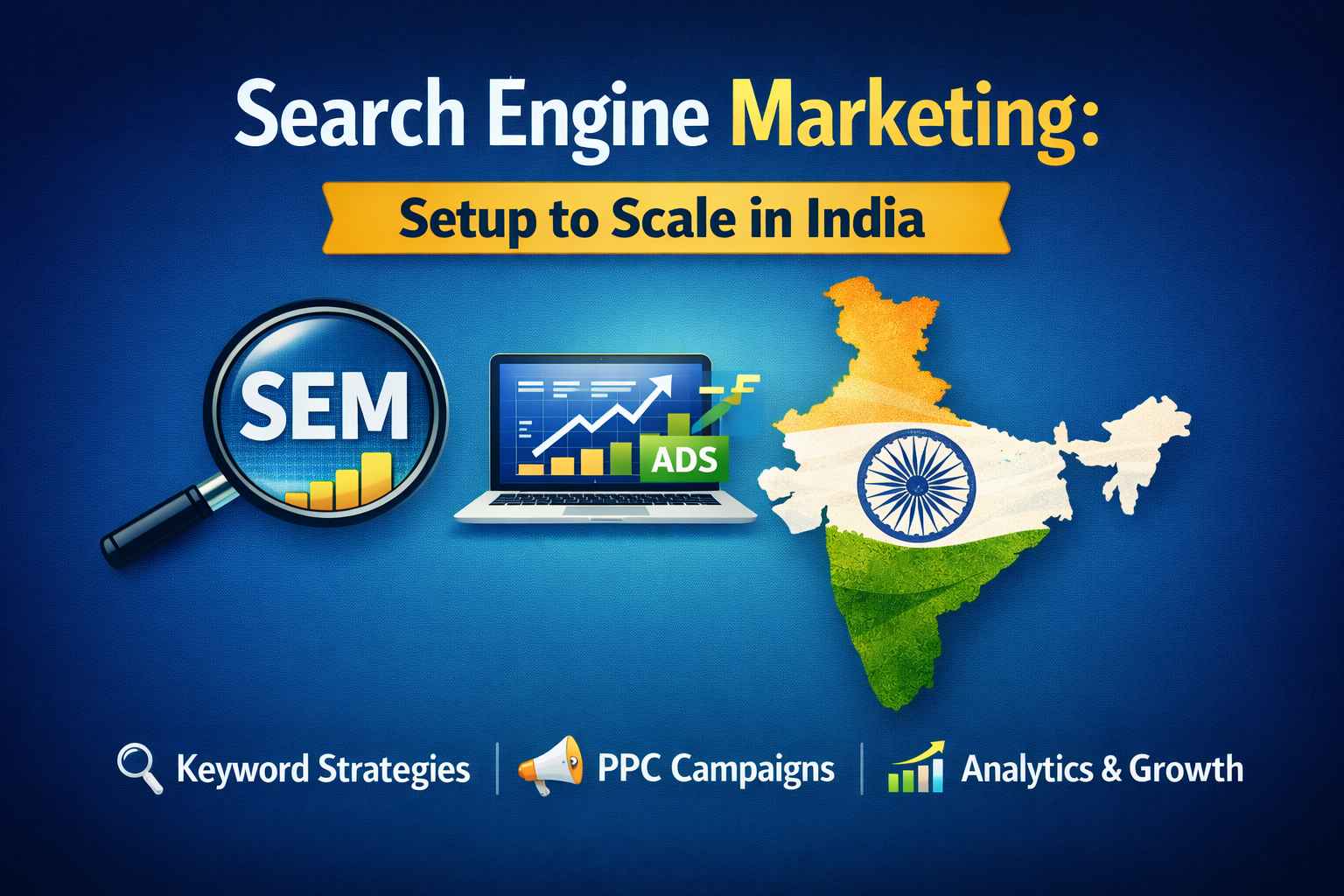
Search engine marketing (SEM) in India can feel deceptively simple: open Google Ads, add a few keywords, set a daily budget, and wait for leads.
In practice, Indian auctions are crowded, mobile-first behaviour is the default, and a large share of conversions happen through calls, WhatsApp, or offline follow-ups. The difference between “we tried Google Ads” and “SEM is our predictable growth channel” comes down to setup quality and a scaling plan that protects efficiency.
This guide walks through a practical setup-to-scale SEM framework for India, with a focus on Google Search campaigns, conversion tracking, landing pages, and the optimisation loops that unlock profitable growth.
What “SEM success” looks like in India (before you touch Google Ads)
SEM is not only about traffic. It is about buying qualified intent at a cost that still leaves margin after discounts, delivery, commissions, and sales follow-up.
Before launching, define success in business terms:
- Lead-driven businesses (services, B2B, clinics, education): cost per qualified lead, lead-to-sale rate, revenue per lead, sales cycle length.
- E-commerce and D2C: contribution margin after ads, ROAS (with caution), new vs returning customer split, repeat rate.
- Local businesses (Chennai and other cities): calls, direction requests, booking completions, store visits (when measurable).
A simple rule: if you cannot measure a conversion reliably, you cannot scale confidently.
Step 1: Build the measurement foundation (GA4 + Google Ads)
In 2026, the biggest SEM waste is still the same: paying for clicks without clean conversion data.
Choose primary and secondary conversions
Set one primary conversion per core campaign goal (or a small set), and track other actions as secondary. Example:
- Primary: “Lead form submitted”
- Secondary: “Click to call”, “WhatsApp click”, “Pricing page view”, “Chat started”
This keeps automated bidding focused while still giving you diagnostic signals.
Set up tracking the right way
At minimum, implement:
- Google Ads conversion tracking (not only GA4 imports)
- GA4 events and key events for broader analysis
- Enhanced Conversions where applicable (hashed first-party data) to improve measurement accuracy
Google’s official references are useful for implementation details:
Don’t ignore offline reality (India-specific)
Many Indian businesses close leads on calls or after site visits. If your team uses a CRM (even a basic one), plan for:
- Offline conversion imports (qualified lead, booked appointment, closed deal)
- Capturing GCLID/GBRAID/WBRAID where possible
This is often the turning point from “Google Ads brings leads” to “Google Ads brings revenue”.
Step 2: Map Indian search intent into campaigns (structure beats hacks)
A scalable account structure mirrors how people search.
Start with intent, not with every keyword tool suggestion
For India, intent clusters typically look like:
- High-intent “service + location”: “dermatologist in chennai”, “interior designers in anna nagar”, “gst consultant near me”
- Comparison intent: “best CRM for small business india”, “seo agency chennai pricing”
- Urgent problem intent: “ac repair emergency”, “24 hour plumber”, “same day courier”
- Brand and competitor intent (where legally and ethically appropriate)
Then turn intent into campaigns with clean boundaries.
A practical campaign model (works for most Indian SMEs)
| Campaign type | What it targets | When to use | Common KPI |
|---|---|---|---|
| Brand Search | Your brand name and variations | Always, to protect branded demand | CPA, impression share |
| High-intent Non-Brand Search | “service/product + location”, “near me” | Core lead/sales driver | CPA, conversion rate |
| Mid-funnel Search | “best”, “top”, “pricing”, “reviews” | If you have landing pages that answer evaluation questions | CPA, assisted conversions |
| Remarketing (Display/YouTube) | Past visitors and engaged users | Once you have enough traffic and a clear offer | CPA, view-through lift |
| Performance Max (where relevant) | Multi-network, asset-driven | Often best for e-commerce with Merchant Center | ROAS, incremental revenue |
If you are a local service business, keep Search as your foundation. Add other networks only when Search data is stable and conversion tracking is trusted.
Step 3: Keyword strategy for India (match types, negatives, and language reality)
Use match types to control scale
A common scalable setup is:
- Exact and Phrase for your highest-intent terms (control and quality)
- Broad only when:
- conversion tracking is reliable
- you have strong negatives
- you can evaluate search terms daily/weekly
Broad can scale in India, but only if you can protect the funnel from irrelevant queries.
Negatives are not optional
India-specific negative keyword themes often include:
- “free”, “pdf”, “jobs”, “salary”, “internship”, “course” (unless you sell courses)
- “government”, “scheme”, “subsidy” (depends on vertical)
- City mismatches (if you serve only certain areas)
Build a shared negative list early, and keep adding to it from the Search terms report.
Language and localisation tips
India is multilingual, but many high-intent searches still happen in English, mixed English, or Romanised local language. Test:
- English + common variants (for example, “Coimbatore” vs “Kovai”, “Bengaluru” vs “Bangalore”)
- Transliteration keywords if your market uses them
For ad copy, consider location cues and trust cues that matter locally (response time, pricing transparency, certifications, warranties, service areas).
Step 4: Create ads that win Indian auctions (RSAs + assets)
Google’s Search ecosystem in India is competitive. You win with relevance and landing page experience, not only bids.
Responsive Search Ads (RSAs): write for clarity
Aim for:
- Headlines that match the query’s intent (service, location, outcome)
- Proof points (years in business, ratings, guarantees, certifications) only if true
- A direct CTA (“Get Quote”, “Book Consultation”, “Call Now”)
Avoid vague claims like “No.1 in India” unless you can substantiate them.
Use assets that matter for Indian users
High-impact assets commonly include:
- Sitelinks (Pricing, Case Studies, Service Areas, Contact)
- Call asset (especially for local services)
- Structured snippets (Services, Brands, Types)
- Location asset (if applicable)
These assets increase ad real estate, and often lift CTR and conversion rate.
Step 5: Landing pages that convert Indian traffic (and improve Quality Score)
SEM performance is often limited by the landing page, not the ads.
Landing page checklist
A strong India-ready SEM landing page typically includes:
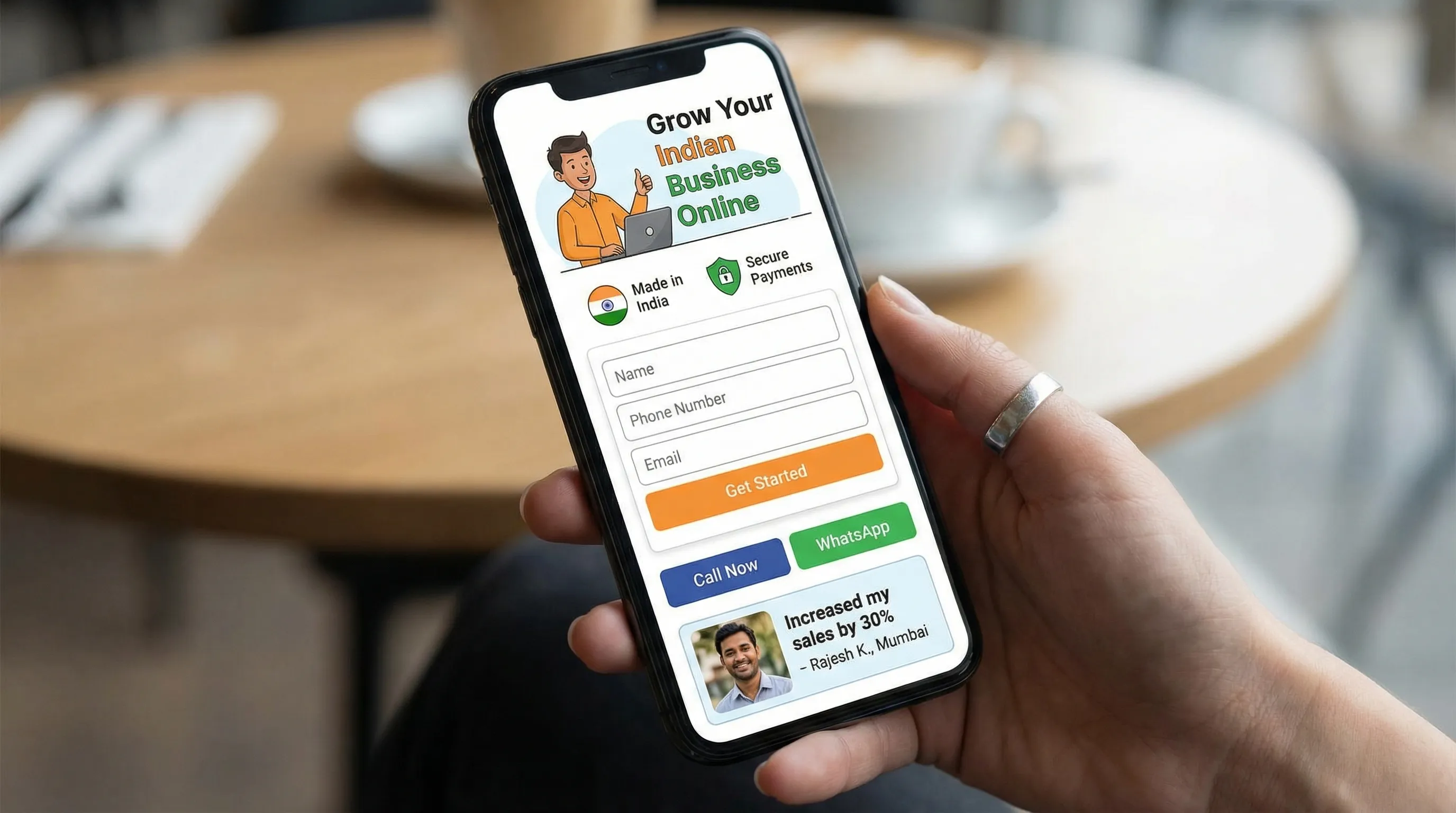
- A clear offer above the fold (what you do, who it is for, what happens next)
- Fast mobile performance (Indian traffic is heavily mobile)
- Click-to-call and WhatsApp options (if your sales process supports it)
- Trust builders: testimonials, client logos, case studies, certifications (only real)
- A short form (name, phone, requirement), with an expectation set (“We call within X minutes/hours” only if you can keep it)
Google highlights landing page experience as part of ad rank. Improving UX can reduce your effective cost per click by improving relevance.
Step 6: Budgeting and bidding, from setup to stable performance
Start with learning budget, not your full target budget
In India, you can burn through budget fast on broad queries. A controlled start helps you learn:
- Which keywords actually convert
- Which locations and times produce qualified leads
- Which landing page angle works
As a planning baseline, many teams use: daily budget that can buy 20 to 50 clicks/day in the main ad group during the learning phase (your CPC decides the number).
Bidding approach: a sensible progression
A common progression:
- Start with Maximise Clicks (only briefly) or manual control if you have strong internal expertise
- Move to Maximise Conversions once conversion tracking is solid
- Move to Target CPA when you have enough conversion volume and stable conversion quality
Automated bidding is powerful, but it needs clean conversion signals. If you optimise for low-quality leads, the algorithm will scale low-quality leads.
Step 7: Optimisation loops (the weekly habits that unlock scale)
Scaling is not a single button. It is a system.
Weekly SEM routine (high leverage)
| Optimisation task | What you do | Why it matters |
|---|---|---|
| Search terms review | Add negatives, find new winners | Protects spend, finds scale |
| Location and device performance | Adjust targeting and bids, or segment | India is highly mobile, local intent varies |
| Ad testing | Refresh headlines, improve CTAs | CTR and relevance improve efficiency |
| Landing page iteration | Improve speed, clarity, proof | Conversion rate gains compound |
| Lead quality review | Tag leads as qualified/unqualified | Prevents optimising to junk leads |
If you can only do one thing weekly, do search terms plus lead-quality checks.
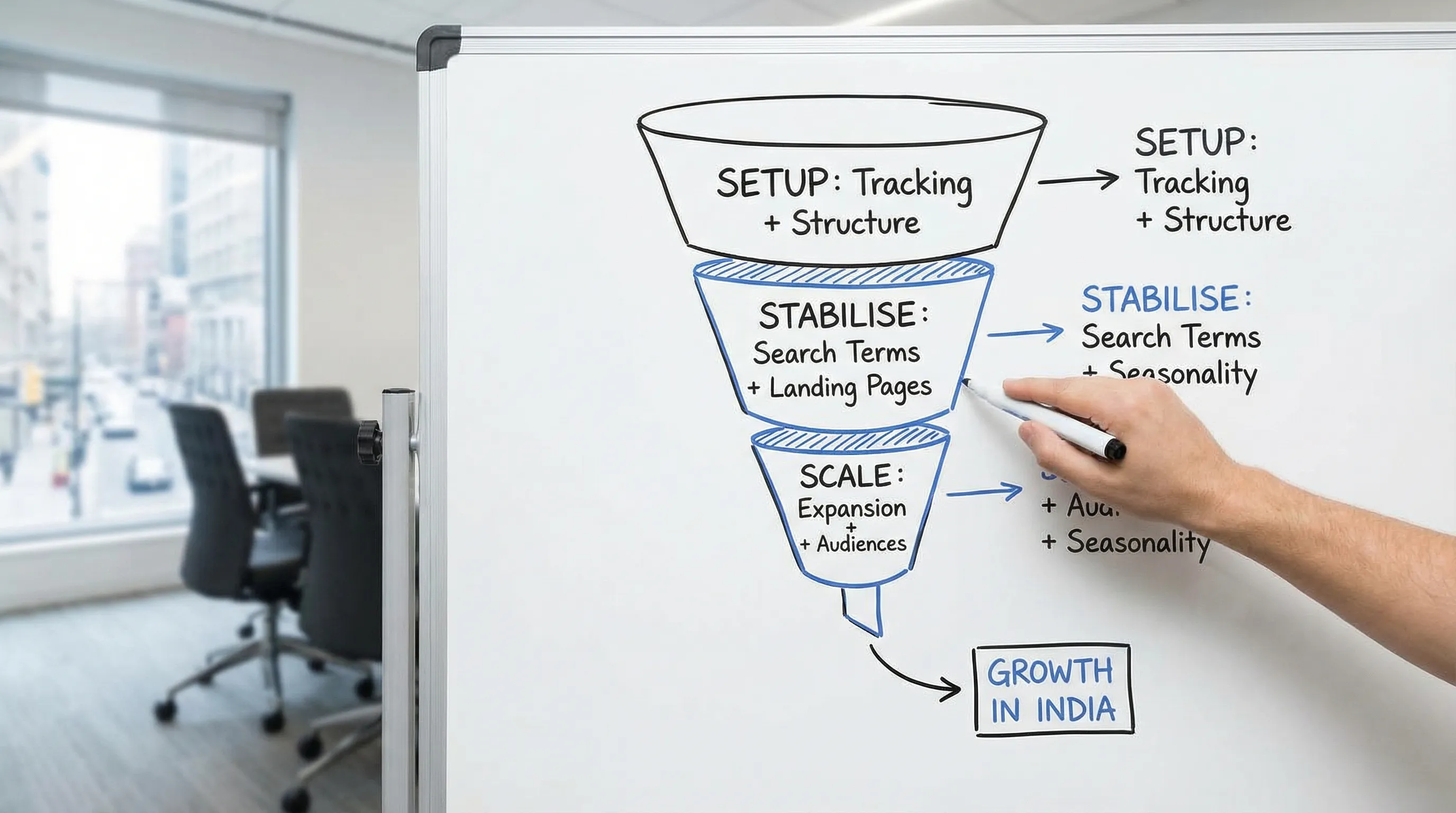
Step 8: How to scale SEM in India without losing profitability
Once your base campaigns are stable, scale with control.
Scale lever 1: Expand coverage systematically
Good expansion paths:
- Add nearby locations you can truly serve (for example, expanding within Chennai zones, then to nearby cities)
- Add “problem” keywords (symptom or need-based searches)
- Add high-intent long-tail variants discovered in search terms
Avoid scaling by dumping hundreds of broad keywords into one ad group.
Scale lever 2: Segment by value (not only by volume)
If you offer multiple services or products, segment campaigns by:
- Margin
- Lead-to-sale rate
- Sales capacity
In many Indian businesses, one service line looks “cheap” on CPL but closes poorly, while another has a higher CPL but far higher revenue.
Scale lever 3: Use first-party audiences
With privacy changes and rising competition, first-party data becomes a moat.
Practical plays:
- Customer lists (existing buyers, high LTV customers)
- Engaged site visitors (time on site, multiple page views)
- CRM stages (MQL, SQL, won) for offline imports
For ecommerce, connect Google Merchant Center for Shopping and Performance Max (when relevant), and keep your product feed clean.
Scale lever 4: Align SEM with seasonality in India
Plan campaigns around India’s demand spikes:
- Festive periods (Navratri, Diwali, Pongal, Onam depending on region)
- Wedding seasons
- School and college admission cycles
- Year-end business budgets (for B2B)
Scaling works best when your offer and landing pages reflect the season, not only the keyword list.
Common SEM mistakes we see in India (and how to avoid them)
Mistake 1: Treating “leads” as equal
A flood of irrelevant calls can look like success in Google Ads while your sales team burns out. Fix this by:
- Tracking qualified leads as a separate conversion (or importing offline conversions)
- Tightening keywords and adding negatives
- Updating landing pages to discourage wrong-fit enquiries
Mistake 2: One campaign for everything
When brand, generic, and competitor keywords sit together, you lose clarity on profitability and you cannot scale responsibly. Separate them.
Mistake 3: Sending all traffic to the homepage
Homepages rarely answer a specific query well. Build landing pages by intent (service pages, city pages, pricing pages where appropriate).
Mistake 4: Optimising only for CPC
A lower CPC can mean lower intent. Optimise for cost per qualified lead or profit, not for the cheapest click.
When to bring in an SEM agency (and what to ask)
If SEM is business-critical, an experienced partner can help you get to profitable scale faster, but only if the relationship is measurable.
Ask any agency:
- How will you set up conversion tracking and validate it?
- How do you report lead quality, not only leads volume?
- What is your approach to search terms hygiene and negatives?
- How do you plan landing page testing and CRO?
- What is your 30/60/90-day plan to stabilise and scale?
How Gilead Digital can help
Gilead Digital is a Chennai-based digital marketing agency offering SEO, PPC (including Google Ads), content marketing, social media marketing, and web design and development. If you want help setting up SEM correctly, or you want to scale an existing account with better tracking and landing pages, you can reach the team via the website: Gilead Digital.
If you prefer speaking directly, the contact number listed on the site is 9003116482.