
E-E-A-T — Experience, Expertise, Authority, and Trust — has become one of the most critical ranking signals in Google's evaluation framework. For Indian brands competing in an increasingly crowded digital space, building topical authority is no longer optional.
This guide provides a structured 90-day action plan that any Indian brand can follow to establish meaningful E-E-A-T signals and grow organic visibility.
Why E-E-A-T Matters More in India in 2025
Three factors make E-E-A-T especially important for Indian brands right now:
- Growing internet user base: India is expected to add approximately 300 million new internet users by 2027, intensifying competition across all search categories
- Multilingual search surge: Search in Hindi and regional languages is growing rapidly. Brands that establish authority in these languages gain a significant advantage
- YMYL scrutiny: Categories like finance, health, and education fall under "Your Money or Your Life" classification and require strict E-E-A-T compliance to rank
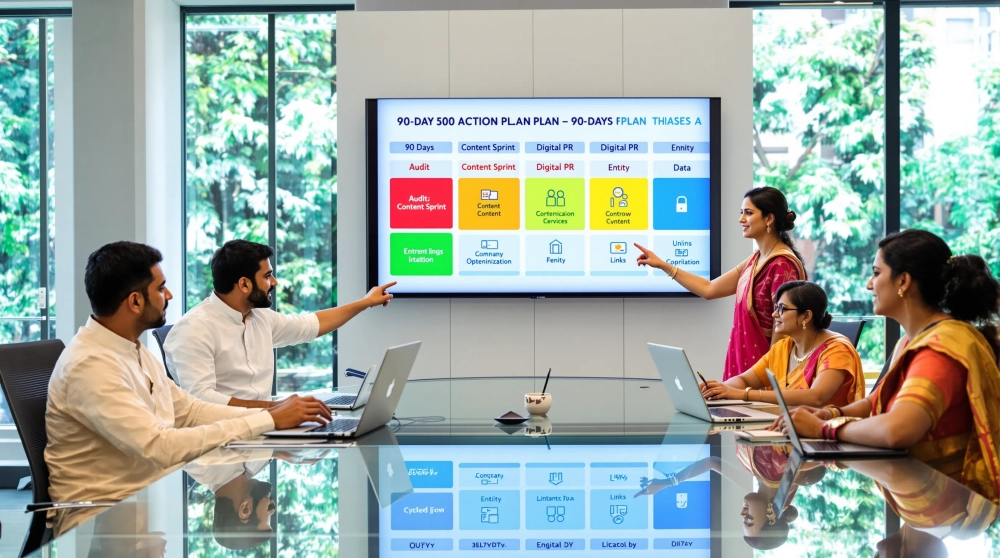
Phase 1 (Weeks 1-2): Audit and Opportunity Mapping
The first two weeks focus on understanding where you stand and where the biggest opportunities lie.
- Entity audit: Use tools like Kalicube Pro to assess how Google understands your brand entity. Check your Knowledge Panel status, branded search results, and entity associations
- Content gap analysis: Pull data from Search Console and competitor research tools. Identify topics your competitors rank for that you have not covered
- Trust signal review: Audit your website for missing author bios, customer reviews, privacy documentation, and clear contact information. These are foundational E-E-A-T signals
Phase 2 (Weeks 3-6): Content Sprint and SME Collaboration
This phase is about building the content foundation that demonstrates expertise and experience.
- Pillar content: Create 2 to 3 core pillar pages (2,500+ words each) authored by certified experts or senior team members with verifiable credentials
- Supporting spoke articles: Publish 8 to 10 supporting articles targeting specific long-tail queries that link back to your pillar pages
- Original media: Integrate original photography, expert quotes, customer testimonials, and data from your own research. Google rewards first-party data and unique perspectives
- Author pages: Create detailed author bio pages with credentials, publications, social profiles, and relevant certifications
Phase 3 (Weeks 7-10): Digital PR and Link Earning
Authority signals come largely from external validation. This phase focuses on earning that recognition.
- Target authoritative publications: Identify Indian publications, industry sites, and niche blogs with strong authority signals. Focus on outlets your target audience reads
- Data-driven pitches: Create media pitches based on original data, surveys, or unique insights. Journalists are more likely to link to content that provides something new
- Regional language content: Repurpose your best content into regional language op-eds for regional news outlets and industry publications
- Link earning target: Aim for 20+ contextual backlinks from domains with authority rating of 50 or above by the end of week 10
Phase 4 (Weeks 11-12): Entity Optimisation and Review
The final phase focuses on reinforcing your entity signals and measuring results.
- Structured data: Deploy comprehensive schema markup including Organization, Article, Person, and FAQ types across all relevant pages
- Entity platforms: Update or create entries on Wikidata, Crunchbase, LinkedIn Company Page, and industry-specific directories
- Baseline comparison: Compare your current metrics against the baseline captured in Phase 1. Document improvements and identify areas for continued focus
Performance Metrics: Baseline vs 90-Day Target
| Metric | Baseline | 90-Day Target | Tool |
|---|---|---|---|
| Topical keywords in top 20 | 180 | 450 | Semrush |
| E-E-A-T page score | 45/100 | 75/100 | Manual rubric |
| Monthly organic clicks | 12,000 | 25,000 | GSC |
| Referring domains | 210 | 260 | Ahrefs |
| Brand Knowledge Panel | No | Yes | Google SERP |
Indian-Specific Tactics for E-E-A-T
Indian brands have unique opportunities to strengthen E-E-A-T signals:
- Government accreditations: Include registration numbers from bodies like the Medical Council of India (MCI), FSSAI, BIS, or relevant regulatory authorities in author bios and company pages
- Regional awards and recognition: Feature awards from FICCI, IAMAI, state MSME accolades, and industry-specific bodies. These serve as trust signals for both users and search engines
- Hyperlocal citations: Build citations through local chambers of commerce, business networks, and regional business directories. These strengthen local authority signals
Case Study: Nattika Beach Ayurveda Resort
Using this framework, Nattika Beach Ayurveda Resort grew from 26 to 520+ ranking keywords over four months. The key drivers were expert-authored wellness content, structured data deployment, and targeted digital PR in the hospitality and wellness space.
Common Pitfalls to Avoid
- Relying solely on AI-generated content: AI drafts need human expertise verification. Publishing unedited AI content can harm E-E-A-T signals rather than help them
- Generic author bylines: Publishing under "Admin" or "Team" without individual author credentials undermines your expertise signals. Invest in proper author pages
- One-time link campaigns: E-E-A-T requires sustained effort. A single burst of link building followed by months of inactivity does not build lasting authority. Plan for continuous topical expansion
Frequently Asked Questions
01 Can a small startup build topical authority in 90 days?
Yes. Small startups can achieve meaningful authority in 90 days by focusing on a micro-niche rather than trying to cover broad topics. Narrow your topic cluster, produce expert content consistently, and build targeted backlinks from niche-relevant publications.
02 Do I need a Wikipedia page for E-E-A-T?
No. A Wikipedia page is not required. Wikidata entries and comprehensive schema markup (Organization, Person, Article) often provide sufficient entity signals. Focus on building a consistent digital footprint across authoritative platforms.
03 Are quality backlinks more important than quantity?
Absolutely. Ten high-authority, contextually relevant backlinks from domains with authority rating above 50 outweigh 100 generic directory links. Focus on earning links from trusted industry publications, news sites, and educational institutions.
04 Should I translate content into regional languages?
Yes, if your audience search behaviour supports it. Regional language content can unlock significant search volume in Hindi, Tamil, Malayalam, and other Indian languages. Ensure translations are professionally done — not just machine-translated.
Conclusion
Building topical authority through E-E-A-T is not a one-time project — it is a systematic process that compounds over time. The 90-day framework outlined here gives Indian brands a practical starting point that covers all four pillars: Experience, Expertise, Authority, and Trust.
Start with a thorough audit, invest in expert-led content, earn authoritative backlinks, and reinforce your entity signals with structured data. The brands that execute this consistently will outrank competitors who rely on shortcuts.
For a customised E-E-A-T strategy tailored to your industry and market, contact Gilead Digital or call us at 9003116482.